[World Cup 2026] Korea Draws Czechia, and the Gap With Japan Shows: A Technical Breakdown
Translated from the original Korean post. 한국어 원문 보기 →
Same Day, Opposite Results
Yesterday (April 1) was a strange one if you follow football. Korea and Japan both played away in Europe on the same day, and the results went in opposite directions. Korea lost 0-1 to Austria. Japan beat England 1-0 at Wembley.
I have a bad habit of watching football the way I'd read a system. Two Asian sides, wildly different approaches, wildly different outcomes — that's interesting to me. One team ran a finished system. The other still felt like it was in the build phase. There's more here than a scoreline.
Breaking Down Hong Myung-bo's Korea
More Stable, Same Output
The 3-4-2-1 Hong rolled out this time was clearly more solid than what we saw against Côte d'Ivoire. But that's where it stops. It reminded me of a refactor that kills the bugs without moving the performance numbers at all.
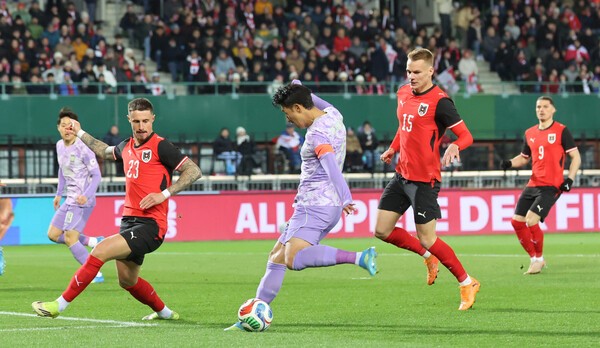
Austria controlled the game with possession — Korea had 44.6%. Yet Korea led on shots, 11 to 5. Shots on target: two.
On paper the chances were there. The problem is what happens next. The conversion rate at the final step is way too low. It's the same shape as traffic pouring in while almost nothing actually gets served. Wide entrance, blocked exit.
Breaking the Press, and Failing to Build
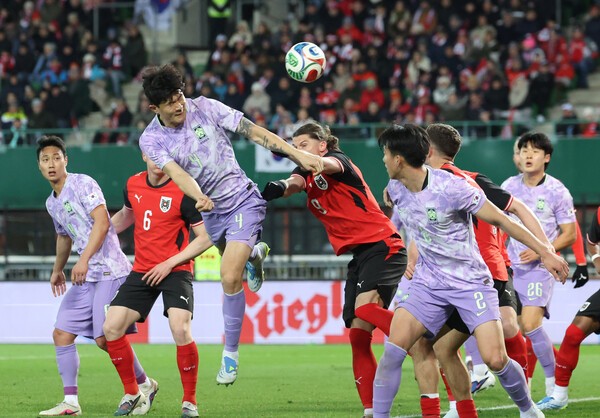
Watching Korea absorb Austria's high press, the layers looked like they were operating independently of each other.
When the first line gets pressed, the second and third have to step up and support it. Instead the lines came unlinked, and the ball kept getting lost in midfield.
Build-up is a dependency between layers. If the second line can't create a passing lane while the first line is under pressure, no amount of individual quality moves the ball forward. Yesterday it kept breaking at exactly that seam.
Why Japan Won: A Systems Answer
What Accumulation Looks Like at Wembley
Japan beating England wasn't a fluke. Read it as the output of everything built under Hajime Moriyasu. This wasn't one good night — it was a system that's been running a long time finally landing a clean hit.
Mitoma's opener says it all. Win the ball, transition immediately, finish it himself. Press and counter with no gap in between.
It looked like a well-designed API call. Each module — each player — handles exactly its own slice of responsibility and hands off. Nobody's reaching for the spotlight, and the whole thing still moves. There's a particular lack of waste you only see when a system has settled.
Systems Don't Appear Overnight
The real strength of Japanese football, I think, is the steady habit of importing outside technique and making it their own. It's like pulling a good library from the open source ecosystem into your project. The value isn't in the import — it's in reshaping it to fit your codebase and carrying the maintenance. Japan has been doing that internalization for a long time.
Scouting Czechia: Korea's First Test
They Beat Denmark and Punched Their Ticket
Czechia knocked out Denmark on penalties yesterday, confirming them as Korea's first opponent in Group A. June 11, in Zapopan, Mexico.
| 구분 | 체코 특징 | 한국 대응 과제 |
|---|---|---|
| 공격 스타일 | 중원 점유 + 긴 전환 | 중원 압박 강화 |
| 핵심 선수 | 파트리크 시크 (박스 공략) | 공중볼 대응 |
| 전술적 특징 | 세컨드볼 연속 처리 | 볼 클리어런스 정확도 |
What the Denmark Game Showed
A third-minute opener showed how quickly they can move the ball. Holding the lead into extra time says something about their conditioning. Taking it to penalties and converting is a mental-management thing.
They're particularly good in the air and on second balls. Block them once and they'll gather the loose ball and come again, twice, three times. Attacks with a retry attached, not a single shot. That's exhausting to defend. This is where Korea will struggle.

What Korea Has to Fix
1. Optimize the Architecture
Start with the bottlenecks in the current 3-4-2-1. Left-right balance between the wing-backs is a resource distribution problem. Midfield progression means fixing the press-resistance logic. Final-ball accuracy is work at the finishing stage.
2. Spread the Son Heung-min Dependency
The attack is a single point of failure. Block Son and the whole system stops. In operations this is the shape that scares me most — everything hums along fine until that one node dies and the entire service goes down with it. Opponents know it too. If you only have to lock down Son, your defensive plan gets very simple. Korea needs a second and third attacking path to share the load.
3. Build Press Resistance
Korea has to develop a tolerance for the organized pressing European sides bring. This isn't about individual skill. It's about how the whole system links up. One player having a good night doesn't fix it — what matters is how the entire line reacts when the press arrives.
What to Work On With the Time Left
Priorities First
Line-to-line connection needs immediate attention. Set-piece defending for the Czechia game is the short-term task. Diversifying the attack is a medium-to-long-term project.
There's a little over two months until Czechia. You can't fix everything in that window. Go after the high-impact items first. Same as incident response: you chase the root cause, you don't start by clearing trivial warning logs.
Realistic Targets
Korea isn't going to have a finished system overnight the way Japan does. So set the goals in stages. Game one against Czechia: clean sheet, one goal from a set piece. Game two: confirm the system is stable. Game three: the full tactical picture.
Closing Thoughts
One day was enough to make the gap obvious. Japan showed a finished system. Korea showed a list of things to fix.
Development isn't so different. Finding the bug is step one, fixing it is step two. The genuinely dangerous state is not knowing where the problem is. By that measure, this Korea side is at least at the point where what's broken is clear. As starting points go, that's not bad.
The Czechia game will be the litmus test. Two months of work, and we find out how it holds up for real. I'm about half hopeful and half worried.
Was this post helpful?
One click helps me write the next one